The search engine optimization landscape is experiencing its most disruptive paradigm shift since the inception of page ranking algorithms. With the rise of conversational search engines like Perplexity AI, ChatGPT Search, and Google Gemini, the traditional concept of the search engine results page (SERP) is transforming. Users no longer simply browse a list of ten blue links; instead, they consume synthesized, multi-source answers generated in real-time. As search behavior shifts towards conversational queries, implementing a dedicated perplexity rank tracker has become an absolute necessity for modern SaaS enterprises and digital marketers looking to maintain organic visibility.
Table of Contents
- 1. The Shift from Google SERPs to Perplexity AI
- 2. Why You Need a Dedicated Perplexity Rank Tracker
- 3. 5 Golden Rules for Tracking Your AI Search Visibility
- 4. How to Choose the Right Perplexity Rank Tracker
- 5. Traditional SERP Tools vs. AI Rank Trackers
- 6. Actionable GEO Strategies to Boost Your Perplexity Rankings
- 7. FAQ: Navigating AI Search and LLM Rank Tracking
- 8. Conclusion: Securing Your Future in the AI Search Era
1. The Shift from Google SERPs to Perplexity AI
Traditional search engines operate on an index-and-retrieve model. Google crawls the web, indexes pages, and ranks them based on hundreds of signals like backlinks, user experience, and keyword optimization. When a user searches, Google presents a list of relevant URLs. However, Perplexity AI operates on a Retrieval-Augmented Generation (RAG) framework. When a query is submitted, Perplexity performs a real-time web search, extracts key information from top-performing sources, and uses a Large Language Model (LLM) to synthesize a comprehensive, conversational answer.
In this new environment, the traditional "rank 1" spot is replaced by the "primary citation." If your website is not cited in the footnotes or the inline links of these generated answers, your organic traffic will plummet. This shift has birthed Generative Engine Optimization (GEO). While a traditional Best SEO Checker can analyze keyword density and backlink profiles, it cannot simulate or track the probabilistic nature of LLM responses. To succeed in 2026, brands must pivot from tracking keywords to tracking conversational citations.

2. Why You Need a Dedicated Perplexity Rank Tracker
Traditional rank tracking tools are fundamentally blind to conversational search engines. They scrape standard HTML search results, looking for domain names in organic listings. They cannot parse the dynamic, personalized, and context-dependent text blocks generated by Perplexity. A dedicated perplexity rank tracker solves this problem by querying LLM APIs directly and using advanced semantic algorithms to measure your brand's presence within the generated text.
Furthermore, Perplexity's results are highly fluid. Because the model synthesizes answers on the fly, a response generated in the morning might differ from one generated in the afternoon, even for the exact same query. A specialized tracker performs multi-pass monitoring, querying the engine at different times and from various simulated user locations to provide an accurate, aggregated visibility score. Without this data, you are flying blind in an ecosystem that is rapidly capturing market share from traditional search giants.
3. 5 Golden Rules for Tracking Your AI Search Visibility
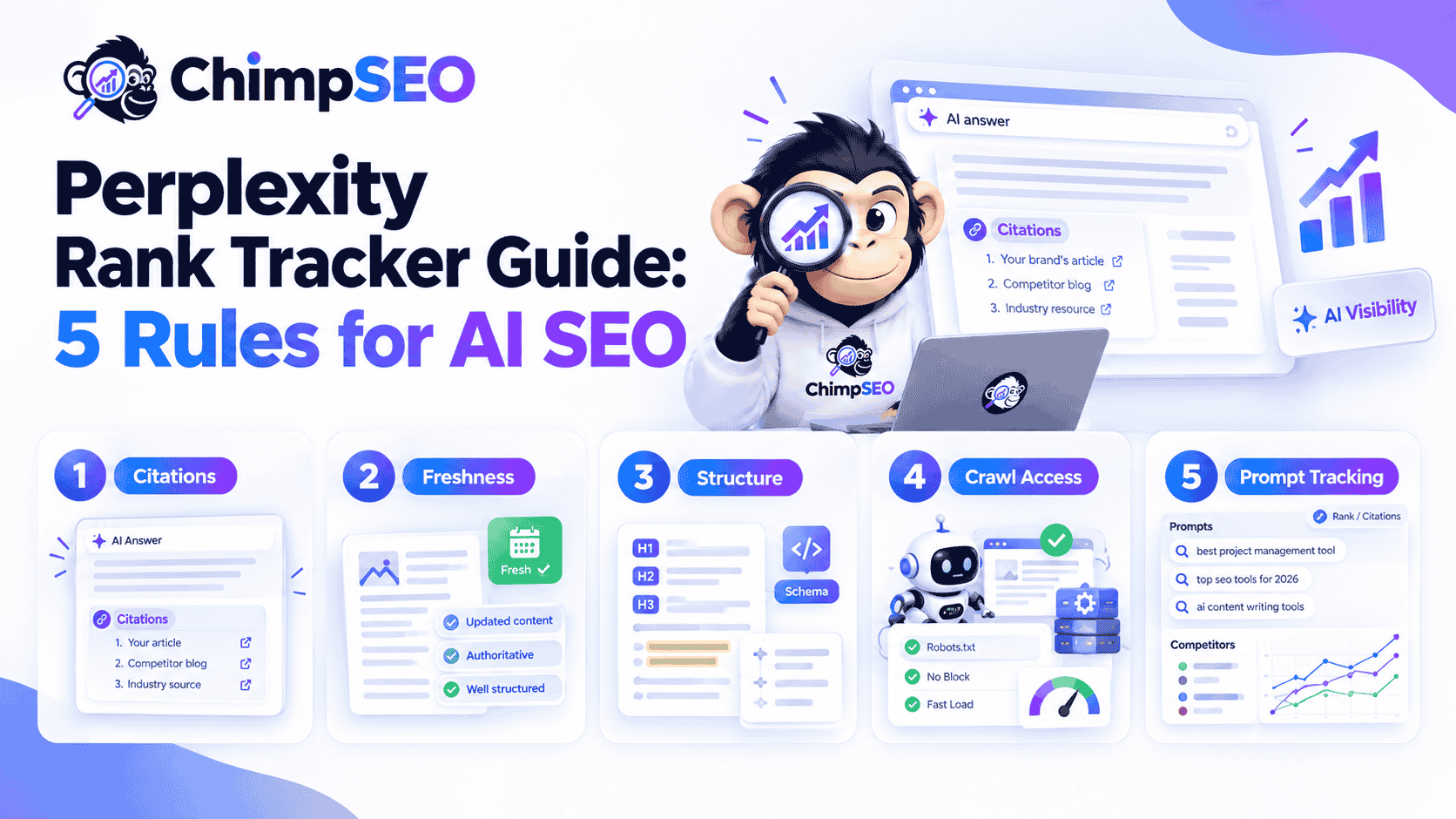
To successfully transition your SEO strategy to the generative era, you must establish a structured tracking methodology. Here are five non-negotiable rules for monitoring your performance using a perplexity rank tracker.
Rule 1: Focus on Citation Share over Absolute Rank
In conversational search, absolute ranking positions (e.g., Position #1, #2, #3) are less relevant than "Citation Share." Citation Share measures the percentage of citations within a generated answer that point to your domain. For example, if Perplexity generates a 200-word summary about "best CRM software" and includes five citations, and two of those citations link to your website, your Citation Share for that query is 40%. A high citation share establishes your brand as the dominant authority in the generated context.
Rule 2: Monitor Conversational Query Variations
Users do not search Perplexity using short, fragmented keywords like "best CRM." Instead, they ask complex, multi-clause questions: "What is the best CRM for a small SaaS business that integrates with Slack and costs under $50 a month?" Your tracking strategy must reflect this. Your tracker should monitor long-tail, natural language queries that match the exact phrasing real users employ when interacting with AI assistants.
Rule 3: Track Brand Sentiment and Association
LLMs do not just link to your site; they write about your brand. Therefore, tracking brand sentiment within the generated text is critical. If Perplexity cites your product but describes it as "expensive and lacking integrations," your organic visibility is actually harming your business. Modern rank trackers utilize sentiment analysis to determine whether your brand is mentioned in a positive, neutral, or negative light, allowing you to refine your product positioning and PR campaigns.
Rule 4: Analyze Source Authority and Context
Perplexity AI relies heavily on trusted, authoritative domains to build its answers. When tracking your rankings, you must also analyze the co-citations—the other websites cited alongside yours. If you are frequently cited alongside industry giants, the LLM views your content as highly authoritative. If you are cited alongside low-quality directories, your content may lack the depth required to secure primary citations for high-value queries.
Rule 5: Measure Real-Time Indexation Latency
Because Perplexity performs real-time web searches, it can index and cite newly published content within minutes. This is a massive departure from Google, which can take days or weeks to index and rank new pages. Your tracking workflow should measure how quickly your newly published articles or press releases start appearing in Perplexity's citations. This allows you to leverage breaking news and real-time trends far more effectively than your competitors.

4. How to Choose the Right Perplexity Rank Tracker
When evaluating a perplexity rank tracker, look for enterprise-grade features that go beyond simple API calls. The platform should offer robust semantic clustering, sentiment analysis, and geographic search simulation. For businesses operating at scale, choosing a platform that integrates with an enterprise seo software platform is crucial for consolidating data and streamlining reporting workflows.
Additionally, look for tools that offer historical tracking. Because LLMs update their weights and training data continuously, you need to see how your visibility trends over weeks and months. Sudden drops in visibility can indicate that a competitor has optimized their content to align more closely with the LLM's vector embeddings, or that the LLM has updated its source preference algorithms.
5. Comparing Traditional SERP Tools vs. AI Rank Trackers
To highlight the fundamental differences between these two methodologies, let us compare how traditional trackers and AI-focused trackers handle search data across key operational vectors.
| Feature / Metric | Traditional SERP Trackers | AI / Perplexity Rank Trackers |
|---|---|---|
| Primary Metric | Numerical Rank (Position 1-100) | Citation Share & Sentiment Score |
| Query Type | Short-tail, static keywords | Long-tail, conversational prompts |
| Data Retrieval | Scraping static HTML SERPs | API querying & LLM response parsing |
| Result Stability | Highly stable day-to-day | Highly dynamic, probabilistic results |
| Content Analysis | Keyword density & meta tags | Semantic similarity & entity relationships |
Understanding these metrics is as critical as selecting the best visibility checkers for traditional search engines. If you rely solely on legacy tools, you will miss the massive volume of traffic migrating toward conversational interfaces.
6. Actionable GEO Strategies to Boost Your Perplexity Rankings
Once your tracking software is set up and you have identified your baseline visibility, you can begin optimizing your content for generative engines. Unlike traditional SEO, which often rewards backlink volume and exact-match keywords, GEO rewards clear entity definitions, structured data, and direct answers to complex queries.
First, optimize your content structure. Use clear, descriptive headings (H2s and H3s) that directly match conversational queries. Under each heading, provide a concise, factual answer in the very first sentence. This makes it incredibly easy for Perplexity’s retrieval crawler to extract your content and use it as a citation. Second, implement schema markup exhaustively. Structured data helps LLMs build accurate knowledge graphs and understand the exact relationships between your brand, your products, and your industry.
To complement your AI strategy, exploring the free SEO tools available for entity mapping can give you a competitive edge. By mapping your content to recognized entities in Wikidata and other open databases, you make your site a highly trusted node in the global knowledge graph, increasing the likelihood that conversational engines will cite you as a primary source.
7. FAQ: Navigating AI Search and LLM Rank Tracking
What is a perplexity rank tracker?
A perplexity rank tracker is a specialized SEO tool designed to monitor, analyze, and report on how often and how prominently a website is cited within the generative answers produced by Perplexity AI. It tracks metrics like citation share, sentiment, and conversational query visibility.
How does Perplexity AI decide which sources to cite?
Perplexity AI uses a Retrieval-Augmented Generation (RAG) system. It searches the web in real-time for queries, extracts high-relevance text snippets from authoritative, structured, and fast-loading web pages, and synthesizes those snippets into a coherent answer, citing the source URLs as inline footnotes.
Can traditional SEO tools track AI search rankings?
No. Traditional SEO tools are built to scrape standard search engine results pages. They cannot accurately parse the highly dynamic, personalized, and context-dependent conversational outputs of LLM-based engines like Perplexity, requiring the use of specialized rank tracking software.
How often do Perplexity search results change?
Because Perplexity generates answers programmatically and performs real-time web searches, results can change multiple times a day based on new content indexation, algorithmic updates, and the probabilistic nature of the underlying LLM.
What metrics matter most in Generative Engine Optimization (GEO)?
The most critical metrics for GEO are Citation Share (the percentage of citations pointing to your domain), Sentiment Score (the tone of the mention), and Entity Authority (how strongly the LLM associates your brand with specific industry topics).
8. Conclusion: Securing Your Future in the AI Search Era
The rise of conversational search is not a temporary trend; it is the future of information retrieval. As millions of high-intent buyers transition from traditional search engines to AI assistants, brands that fail to adapt will quickly become invisible. Investing in a reliable perplexity rank tracker is no longer optional—it is a critical requirement for maintaining market share and driving sustainable organic growth in 2026 and beyond.
By shifting your focus from keyword rankings to citation share, monitoring conversational query variations, and optimizing your site structure for Retrieval-Augmented Generation, you can position your brand as the undisputed authority in your niche. The tools and strategies outlined in this guide provide the blueprint you need to dominate the next generation of search. Start tracking, start optimizing, and secure your place at the top of the AI-driven web.